Saturday, 16 May 2015

Wednesday, 24 October 2012
JKS England Autumn Technical Seminar with Yamaguchi Sensei (7th Dan JKS) - DAY 2
Morning lesson (10 am - 12 pm)
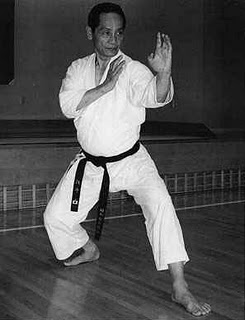
Yamaguchi Sensei (JKS 7th Dan)
Kihon
The main focus of this lesson was on stances. Focusing on the correct knee position, weight distribution and compression. We also focused on the hanme position when stepping forward and back.
One of the exercises to make sure we kept compression in our stances was to go from front stance (weight on front leg), to back stance (weight on back leg), to kiba dachi weight in the middle), to back stance (weight on back leg) then back to front stance again (weight on front leg). We also covered an exercise working on neko ashi dachi:

Kata
The kata's we went through were Gojushiho Sho and Gojushiho Dai. We went through the Kata to count with Yamaguchi Sensei watching, then again with Sensei going through the Kata with us, then finishing with a demonstration by Yamaguchi Sensei (giving us technical feedback and things to change/work on). The following are key points to work on that I picked up at the time in bullet point form;
Please watch the following links to gain many more technical points than the short few mentioned above;
Scott Langley Sensei (JKS 5th Dan)
The key theme of Scott Sensei's lesson was teaching us to use our seichosen (centre) line to move- to stop excess movement, like jumping, and to make both hips work.
Exercise 1:
For example, one the exercises was to punch choku zuki in kiba dachi landing facing 180 degrees facing the opposite side. The key was to drive the punching side hip forward and the hikite side back, keeping a low centre of gravity to spin behind as you punch. Emphasis was on NOT to jump! See the following link for the video of the exercise; Moving from the centre - Scott Sensei
Exercise 2:
Gedan berai 45 degrees backwards, punch gyaku zuki. Drive front hip forward and back hip back to return to kamae. Keeping a low centre of gravity and feet connected to the floor. Again, NO jumping up! Feeling of compression. Here's another video; Keeping Seichosen line to return to kamae - Scott Sensei. This exercise was then progressed onto 1-step kumite; 1 step kumite, moving from the centre - Scott Sensei.
Afternoon lesson (12.30 pm - 2.30 pm)
Yamaguchi Sensei (JKS 7th Dan)
Kata
Again Yamaguchi Sensei went through these kata's in precise detail. Picking out common mistakes we make but also the most minute details so that each technique is performed correctly. All kata's were watched first, then taught as both instructor and students practiced and finally ended with impressive demonstrations by Yamaguchi Sensei. Key points taught will be noted in bullet point form.
Kanku Sho
Bassai Sho
Jitte
Alan Campbell Sensei (JKS 6th Dan)
Kata
Heian Nidan with spinning on each step - to get us to relax our bodies to get more shoulder and hip snap.
Kumite
Basic 1-step kumite - jodan, chudan and mae geri - the block is not the end move!
Soto uke exercise:
Attacker - JODAN attack (right hand)
Defender - step back with right leg
- block right hand, then left hand and attack to their throat (soto uke preparation)
Attacker - punch chudan gyaku zuki
Defender - right hand block down
Attacker - punch chudan zuki
Defender - block soto uke
Attacker - punch chudan zuki
Defender - soto uke hand pulls to hikite to strike/block the attack whilst punching gyaku zuki trapping the attackers elbow then following it through to punch their face.
As you can see from these notes the course on this day was very informative and gave everyone something to take away to work on. Thanks to Scott Langley Sensei for recording parts of the course! Invaluable to have something to watch as well as read back after such an amazing course.
OSU!
Yamaguchi Sensei (JKS 7th Dan)
Kihon
The main focus of this lesson was on stances. Focusing on the correct knee position, weight distribution and compression. We also focused on the hanme position when stepping forward and back.
One of the exercises to make sure we kept compression in our stances was to go from front stance (weight on front leg), to back stance (weight on back leg), to kiba dachi weight in the middle), to back stance (weight on back leg) then back to front stance again (weight on front leg). We also covered an exercise working on neko ashi dachi:

Kata
The kata's we went through were Gojushiho Sho and Gojushiho Dai. We went through the Kata to count with Yamaguchi Sensei watching, then again with Sensei going through the Kata with us, then finishing with a demonstration by Yamaguchi Sensei (giving us technical feedback and things to change/work on). The following are key points to work on that I picked up at the time in bullet point form;
- The empi goes directly in.
- Squeeze shomen to hanme on the turning block.
- On the nukites strike inside the line of the other hand.
- Haishu-uke (back hand strike/block) for the first block in kiba dachi in Gojushiho Sho.
- Haiwan-uke (forearm block/strike) for the second block in kiba dachi in Gojushiho Sho.
- Haito-uke (ridge of hand block) for both blocks in kiba dachi in Gojushiho Dai.
Please watch the following links to gain many more technical points than the short few mentioned above;
 |
| Gojushiho Sho demonstration |
 |
| Yamaguchi Sensei in action |

 |
| Gojushiho Dai |
 |
| Kata Bunkai |
The key theme of Scott Sensei's lesson was teaching us to use our seichosen (centre) line to move- to stop excess movement, like jumping, and to make both hips work.
Exercise 1:
For example, one the exercises was to punch choku zuki in kiba dachi landing facing 180 degrees facing the opposite side. The key was to drive the punching side hip forward and the hikite side back, keeping a low centre of gravity to spin behind as you punch. Emphasis was on NOT to jump! See the following link for the video of the exercise; Moving from the centre - Scott Sensei
Exercise 2:
Gedan berai 45 degrees backwards, punch gyaku zuki. Drive front hip forward and back hip back to return to kamae. Keeping a low centre of gravity and feet connected to the floor. Again, NO jumping up! Feeling of compression. Here's another video; Keeping Seichosen line to return to kamae - Scott Sensei. This exercise was then progressed onto 1-step kumite; 1 step kumite, moving from the centre - Scott Sensei.
 |
| Course photo |
Afternoon lesson (12.30 pm - 2.30 pm)
Yamaguchi Sensei (JKS 7th Dan)
Kata
Again Yamaguchi Sensei went through these kata's in precise detail. Picking out common mistakes we make but also the most minute details so that each technique is performed correctly. All kata's were watched first, then taught as both instructor and students practiced and finally ended with impressive demonstrations by Yamaguchi Sensei. Key points taught will be noted in bullet point form.
Kanku Sho
- The first 3 moves - palms face down to twist in to the morote uke block and forearm snap to create the power.
- Punch to uchi uke position is to escape a wrist lock/grab.
- On the turn and grab before the mae geri - the supporting hand is flat so that the thumb doesn't get bent back (with the application being pulling the attacker onto the mae geri).
- The second "jump" isn't a jump - you must keep a low centre of gravity when turning.
Bassai Sho
- Start - hands are parallel on top of each other, not side by side.
- Next move block behind then to the front in kosa dachi, with your head above the block so you can still see ahead. Kosa dachi is naturally 45 degrees of to the side.
- Application to the turn, catch and pull in kokutsu dachi is catching a bo staff and pulling it away.
- The turning scooping open hand block into gedan berai - don't drop the weight bending knees too much, just natural transition.
- Manji gamae - hand open to close.
- Double ura zuki - make sure both hands come together when striking forward (jodan is a small target).
- Turn ashi berai and jodan soto uke before both hands go to hikite, landing nihon zuki in kiba dachi.
- Last 2 moves - double block then pull hands in (palms facing forwards finishing in neko ashi dachi).
 |
| Yamaguchi Sensei correcting my Bassai Sho |
- Yoi position in line with top of chest/neck.
- First move hips aren't hanme, relaxed shomen position.
- On the slow double block in shizentai - squeeze the inner thighs to bring you up to shizentai smoothly and controlled.
- Manji gamae - hand open to closed.
- Last age uke is more of an attack than a block.
Alan Campbell Sensei (JKS 6th Dan)
Kata
Heian Nidan with spinning on each step - to get us to relax our bodies to get more shoulder and hip snap.
Kumite
Basic 1-step kumite - jodan, chudan and mae geri - the block is not the end move!
Soto uke exercise:
Attacker - JODAN attack (right hand)
Defender - step back with right leg
- block right hand, then left hand and attack to their throat (soto uke preparation)
Attacker - punch chudan gyaku zuki
Defender - right hand block down
Attacker - punch chudan zuki
Defender - block soto uke
Attacker - punch chudan zuki
Defender - soto uke hand pulls to hikite to strike/block the attack whilst punching gyaku zuki trapping the attackers elbow then following it through to punch their face.
As you can see from these notes the course on this day was very informative and gave everyone something to take away to work on. Thanks to Scott Langley Sensei for recording parts of the course! Invaluable to have something to watch as well as read back after such an amazing course.
OSU!
Wednesday, 17 October 2012
JKS England Autumn Technical Seminar with Yamaguchi Sensei (7th Dan JKS) - DAY 1
From Friday 12th - Sunday 14th October 2012 JKS England were proud to host Takeshi Yamaguchi Sensei (7th Dan JKS) at the Autumn Technical Seminar in Nottingham, England. This was the first course in the UK Yamaguchi Sensei has taught since he came over to Dublin, Ireland in 2007. Needless to say the weekend course, which consisted of 10 hours of training, was thoroughly enjoyable & thought provoking. In this blog I will cover what was taught by Yamaguchi Sensei on the Friday night of the course.
"One of the best seminars we've had in many years!" Scott Langley Sensei
(5th Dan, JKS GB & Ireland Technical Director)

Me with Yamaguchi Sensei.
In the 2 hours of training on the Friday night Kihon, Kata and Kumite were covered.
Kihon
The key teaching points or themes to this lesson was that you should be able to kime at any point of the technique - not just when the foot and hand are landing and finishing at the same time. Yamaguchi Sensei was keen to express that there are 5 sections of the body that you can use independently as well as at the same time - these were the head, body, hips, arms and legs.
- When stepping forward into stance use your front hip to drive forward.
- When stepping backwards into stance use your back hip to drive backwards.
Exercises;
- Forward kizami, gyaku zuki in zenkutsu dachi - last punch and foot finish together, punch choku zuki to return to shizentai
- Shuto uke (in kokutsu dachi) is the same principle.
- In kiba dachi - mikazuki geri followed up with mawashi empi, returning back to tate shuto uchi uke.
It was also stressed how important it was to use shoulder snap and to be relaxed when performing striking techniques. There were many various arm swinging exercises used to make us loosen up and relax our shoulders and arms. As well as this, Yamaguchi Sensei also stressed the importance of hip snap too. Once of the exercises for this was to twist the hips side to side. The hips makes the hands move - hips working independently from the upper body!
Tekki Shodan
Here are the key technical points Yamaguchi Sensei made clear about this Kata;
- Start position, hands are in shuto position
- First step is on the ball of the foot (koshi).
- On the chudan haiwan uke the arm is straight and the leg swings up and over.
- On the uchi uke's the hand goes directly back to the hip before blocking to chudan level.
- Before the 2 kiai points; look (one count), double block (second count), look (third count), double block to the other side (fourth count) - hip twist maximum for the double blocks, also use the hips for the foot raises and move in with the strike.
Tekki Nidan and Tekki Sandan were also covered by Yamaguchi Sensei going through more technical points. But for me it was more a case of refreshing my memory of these Kata's! Main thing I gained from this was a sense of humbleness that Kata can easily be forgotten if you don't practice them enough... So more work on all Kata in the future for me!
Kumite
We went through Kihon-Ippon Kumite at the end of the lesson, for the jodan, chudan, mae geri and mawashi geri attacks. First we were told to do one-step by our own count so that Yamaguchi Sensei could inspect our technique, movement and corrections that could be made. For defending jodan and chudan attacks we were told to make full preparation for the blocks and to step directly backwards. For mae geri and mawashi we were told to step backwards and off to an angle whilst blocking then counter.
More advanced defending of mae geri attack would be to go directly forward with a kizami throat strike and gyaku zuki as you land into stance... to stop the attacker before they can get their kick off. For mawashi geri you would go directly forward and to the angle covering the kick before it's finished followed up with an open hand counter strike to the groin.
Here is a short video, thanks to Scott Langley Sensei, of the Kihon-Ippon Kumite demonstrated by Yamaguchi Sensei;
Soon I will be blogging about day 2 and day 3 of the technical seminar, thank you for taking the time to read this blog!
Osu,
Craig Williams (3rd Dan JKS)
Monday, 15 October 2012
Resurrecting the blog
After training with Yamaguchi Sensei this weekend I think I'm going to start blogging again. Uploading course notes & thoughts on here and using this blog as a resource to refer to when planning my personal training and lessons I teach.
Osu,
Craig
Thursday, 11 August 2011
JKS Dan Grading's - My personal experience

I thought I would write about my experience of grading within the JKS organisation. I have in the past heard derogatory remarks from people about the standard of Karate-ka and the grading system of the JKS. Most of the time these individuals actually have no facts about or experience of JKS Karate. It has been claimed that the JKS just hand out grades and are only bothered about taking the money.... this is totally untrue!
Many people I know in the JKS have had to work so hard to achieve their Dan grades. I only have to look to my Sensei Alan Campbell (JKS England Chief Instructor & JKS GB & Ireland Chairman) who passed his Roku Dan (6th Dan) Grading at the JKS Hombu Dojo in Japan , December 2009. Going into the 'lions den' to physically and mentally challenge himself - no mean feat in the 'home' of Karate. This is something for Alan Sensei, his club students and his organisation to take pride in!
Both of my Nidan (2nd Dan) and Sandan (3rd Dan) gradings have been accredited to the JKS and I take great pride in both of these passes! For our organisation to be led by great instructors such as the late Asai Shihan, and now the future of the JKS with Kagawa, Yamaguchi, Kanayama Sensei's and many others that deserve mentioning it's safe to say we are in very good hands! (I say 'our organisation' as the majority of people reading this will be JKS members). Within the JKS GB and Ireland we are also led by 2 excellent Sensei and Karate-ka in our Technical Director Scott Langley (JKS 5th Dan) & our Chairman Alan Campbell (JKS 6th Dan). They in turn are supported by a great bunch of 'senior' Instructors to make our organisation strong and friendly. I believe in what we are taught by our Sensei's in the JKS GB & Ireland and it is made clear we try to practice Karate-do in the right spirit not only to conform to the JKS grading syllabus but to develop our Karate to make it personal to us. It's obvious I am fiercely proud of my Karate lineage.... Seibukan Karate Club, JKS England, JKS GB and Ireland then of course our links to JKS Japan.


Me with Sensei's Scott & Alan on the left and with Shihan Kagawa after my Sandan grading!
No JKS Dan grading is easily passed... this I can promise you! So for a short while I will talk about my experiences and in particular my Nidan grading...
I think it was in September/October 2005 that I attempted to go for my Nidan in Loughborough with Yamaguchi & Kanayama Sensei's. I passed everything apart from my Kihon. Kata - tick! Kumite - tick! Kihon - retry in 3 months! I was absolutely gutted! I was failed on the yori-ashi movement in the Kihon combinations... this made me realise how tough JKS gradings are. How much the Japanese Sensei's want to push you past your limits... For me I believed this was a test of character and spirit! To fail on such a small part of the overall grading was upsetting.... but I think this was Yamaguchi and Kanayama Sensei's way of testing whether or not I'd go away train even harder and come back for more! If I'd have given up I wouldn't have been worth the grade anyway.... So the month's passed and I was told I would be grading in Nottingham, March 2006 with Inada Sensei (Senior JKS Japan Hombu Dojo Instructor and former All Japan Kumite Champion).


Inada Sensei refereeing my Cadet Kumite Bronze medal match at the JKS GB International Open, Crawley, 2004
2006 JKS Nidan Grading and Course with Inada, Alan & Scott Sensei's
This course was very special to me as Inada Sensei seemed to have already of known that I was going for my Nidan grading on his course. So his lessons were based on the Nidan Kihon syllabus and seemed to always focus his attention towards me... not to the exclusion of others.... but he kind of knew when he needed to correct my technique, continually pushing me and working me harder!
Here are a few key points from the weekend's course content......
The main focus during the Kihon training with Inada Sensei was contraction and expansion (open/close).Here are a few key points from the weekend's course content......
Some of the basics (from zenkutsu-dachi) included;
- Gyaku-zuki, back, oi-zuki, gedan berai (key point for this was to keep the striking hand back until the last moment on the oi-zuki making sure the foot/hand finish together).
- Mae-geri, back, step forward mae-geri, gedan berai (hips close, open, close open...).
The grading took place on the Saturday after the course - I was determined not to fail! First up was the Kata section. I'd already passed both Kata and Kumite previously but I was told that I'd be doing the whole grading again just before I took it! I chose Nijushiho as my tokui Kata - which I felt was quite strong. I was then asked to perform Junro Shodan. Great! I didn't know it 100% at that time! Scott Sensei translated this to Inada Sensei... and they were talking for a few minutes (it seemed like an eternity!) then Inada Sensei just said ok.... I could sense a bit of disappointment! I then exclaimed "but I know Junro Yondan!!" Inada Sensei looked surprised... how could I know this but not the first one?? Nevertheless I was asked to perform Junro Yondan and I did so without any mistakes to my relief! Phew! Next up..... Kumite! I thought "YES!!! Let's have it! Not letting anyone stop me from achieving my pass!" I ended up fighting two seniors from my club (James Sempai and Alexander Dolton, our clubs first Sandan who unfortunately doesn't train any more). I was so pumped up for it that I more than stood my ground and tried to dominate the whole way through. YAME! was called and that was that! I was pretty pleased with my performance so far... then came the Kihon! Like always, I tried my best to encorporate what had been taught on the course. I awaited my results after...
- Kumite - PASS!
- Kata - PASS!
- Kihon - retake on Sunday!!! I was gutted! I was told to work on tobi-kondi (step and slide) and yori-ashi (sliding movement in)!
So the course on Sunday with Inada Sensei was based on the Nidan syllabus again! Here are some more lesson notes from the course:
- Tobi-kondi & yori-ashi - slide, weight on front leg, deep impact, body forward and technique right in.... *gaining DISTANCE!
- Mawashi-geri -lead with the knee, go for distance (back foot sliding is ok!) and start kick 'wide' going round and down!!!
- Kizami-zuki, yori ashi, sanbon-zuki - keep going forward, deep stances, complete all punches (no short techniques!) and pull hikite hand in line (not into the body!)
- Kiba-dachi - correct angles, weight ditribution and inner thighs squeeze.
- In kiba-dachi using hip vibrations, Exercise 1 - moving; forward, right, back, left, forward twist forwards then Exercise 2 - moving forward, left, back, right, forward, twist backwards.
- Pivoting exercise (heel to go backwards or ball of foot to go forwards.)
- Kata Bunkai for Heian Shodan and Nidan using attacks or holds.
Then Scott Sensei taught Tekki Shodan, Nidan and Sandan - following on from Alan Sensei's lesson about how important Kiba-dachi is, as well as about timing, control and explosive movements.
The final lesson was taught by Inada Sensei... here are the last few notes I had jotted down:
- Kumite partner work - 1 person attacks, 1 person counter-attacks "counter attacker should have the same thinking of the attacker > attack before they attack you!!"
- According to Inada Sensei there are 3 types of punches/kicks - long, short (you need to vary the distance) or block counter/attack/same time (aiuchi).....
BE THE FIRST ONE IN!!!
More Nidan Basics....
Kamae;
- Back age-uke
- Forward mawashi-geri (distance right in!!!)
- keep going forward same side uraken with no snap back
- with momentum still going forward, step through oi-zuki
- KEY POINT >> flow techniques & deep impact!
Kamae;
- Forward mawashi-geri
- opposite leg forward ashi-berai (foot curved to hook & knee to chest and across body)
- uraken, gyaku-zuki.
I must admit I felt the whole weekend was physically and mentally draining for me... trying my best to take in all the key lesson points and trying my best to pass my grading! At the end of the lesson on the Sunday I had to do the Kihon section of my grading in front of the whole course! I found the an extra store of adrenaline from somewhere and blasted out each combination I was told to do as best as I could! I was that concentrated it felt like I had tunnel vision, no one else was there to me, just me and Inada Sensei, trying my best to achieve the correct performance of my technique as I was taught just hours previously... I was was spent! Nothing left in the tank.... then I heard "Craig Williams.... Nidan.... PASS!!!" I was overjoyed! Part of me was thinking finally! But I knew that this grade meant everything to me... I had to work damn hard for it, not only in the preparation in the months leading upto it but in the grading too! Many of the senior Dan grades on the course, which included the Captain Simon Bligh (mentioned in previous blogs), congratulated me and even commented that what they saw was the hardest Nidan grading they've seen....... and that means a lot when you look at the grade and experience some of the senior grades in the JKS GB & Ireland have got!
The JKS as an organisation is open and very friendly. Courses that are put on by the JKS are open to everyone, all organisations. For us to develop as Karate-ka it is important to broaden our horizon's and gain instruction from top Instructor's... you are encouraged to go out and train with many instructors and gain experience. As long as you stay true to the JKS with regards to your grading's and membership etc. I hope this blog has given you some useful information with regards to the JKS and my personal experiences. Feel free to discuss this topic on my blog! For anyone interested in joining JKS England please contact Simon Bligh Sensei on +44-(0)797-382-9970 and here is a link to the webiste for relevant information on joining JKS England;
http://www.jksengland.com/index.php?option=com_content&view=article&id=11&Itemid=20
Osu!!!

http://www.jksengland.com/index.php?option=com_content&view=article&id=11&Itemid=20
Osu!!!

Sunday, 7 August 2011
My favourite Asai Shihan Kata
I know I've not posted for a while so I thought I'd better sort it out! So my returning blog will be based on the question "What is my favourite Asai Kata and why?" This was asked by Simon Bligh Sensei otherwise known to everyone at Seibukan Karate Club as the 'Captain!'

Since becoming part of the JKS I have become accustomed to being taught to think 'outside the box' and develop my Karate to become personal and effective to me. Over the years we (I say we as in Alan Campbell Sensei's club) have practiced many of Asai Shihan's Kata's. My first memories of seeing and experiencing these 'different' Kata's were at the JKS GB's first ever International Seminar and Championships in Crawley, in 2004. Seeing Asai Shihan and the, at the time, up and coming young Makita Sensei teaching these Kata's - designed to be used as training tools to compliment the Shotokan Kata we already have.
Here's a link to a video of Makita Sensei teaching Junro Shodan and Nidan on the course I mentioned previously:
Also, Makita Sensei demonstrates Kakuyoku Nidan on the same course (you can see a very young me in the background!) in the following link:

Me practicing Unsu in Okinawa
It's difficult to decide which Kata is my favourite as there are so many Asai Kata to choose from. It's like asking what is you're Tokui Kata at different stages in you're competitive career. You like to choose the most 'eye-catching' Kata that you hope would impress the judges. BUT it must encompass good solid Kihon techniques! It should definitely not any involve any theatric or non existant movements! At the moment most people know my Tokui Kata is Unsu, which I performed at successfully in May 2011 to win the JKS Ireland Men's Individual Kata. The reason I like Unsu is for the pace of the Kata, you have the slow, controlled parts and the parts that can show off your athleticism (the four tate shuto gyaku zuki's) and obviously the jump is a big 'eye-catcher!'

JKS Ireland Open 2010 - Me performing Unsu
So if I had to choose one Asai Kata in particular I would have to pick Junro Yondan. Many people that have recently joined JKS England have told me how difficult a Kata this is for them to grasp. For me it was the first Kata I remembered..... I say remembered because I was taught all 5 by Alan Sensei (after we were shown them on courses with various instructors like Kagawa, Yamaguchi, Kanayama, Koike, Inada, Scott Sensei's) but Junro Yondan was the first one to stick in my head! I remember going for my Nidan grading in Nottingham in 2006 with Inada Sensei and when it came to Kata I did Nijushiho as my Tokui, then Bassai Dai was selected for me. I was then asked to do Junro Shodan by Inada Sensei... I didn't know it 100%! Inada Sensei then looked to Scott Sensei..... then I exclaimed "But I know Junro Yondan!!!" Inada Sensei looked confused..... with translation he replied how can you know this without knowing the first one??" But I duly performed Junro Yondan and ended up passing my grading to great relief!
So, it's a Junro Yondan is a favourite as it's a Kata that has brought personal success with regards to my Nidan grading. For some reason I really like techniques and movements that require spinning and pivoting so I feel really at ease with this Kata. Below is another link, of Scott Langley Sensei performing Junro Yondan:
I feel that some of the key themes to this Kata are spinning/pivoting and re-use of the same hand. When spinning forward (leading with the chest/open side) it is best to spin on the ball/middle of your foot but when you spin backwards (leading with your back/closed side) it is more effective to spin on the heel of the foot. To me, Junro Yondan feels like a realistic fighting Kata because you aren't just blocking and countering.... There could be a number of blocks before you're able to counter - just like in a real fighting scenario! Also the Kata shows us that we can block pro actively going forward i.e. the first two moves. The Kata also introduces us to Neko Ashi Dachi again, as well as open hand techniques.
The Junro Kata's are like the Heian Kata's - the basis to support development of good technique and understanding of body mechanics. I believe the key to Asai-Ryu Kata is smooth transitions, relaxation and fluidity - so bare this in mind when learning and refining these Kata's.
Keep training hard and enjoy what you do!
Osu!!!

Monday, 20 June 2011
A Photographer's Journal: Preview
A Photographer's Journal: Preview: "Just a quick preview of of the photos from tonights course with Koike Sensei. More to come tomorrow."
Subscribe to:
Posts (Atom)